
close
General

“The child that is hungry must be fed…”

no thumb

The twentieth century dawned on the eve of a World War, announcing an era of change that would forever reshape humanity and the way it defined itself. As a new political face of the world emerged, millions reeled in the aftermath of a war that closed the chapter to an enchanted 19th century and marked the beginning of the faster paced, often more gruesome 1900’s.

It was no wonder then, after the atrocities and ravages of a war, that global leaders sought for a revival of the human spirit through a special emphasis on the inalienable rights of us all as intelligent, conscientious beings. It was to this backdrop that the movement for children’s rights first began. The world sought to right its many wrongs and guide a future generation by constructing frameworks for a better tomorrow. A new International Labor Office sought to assert the rights of child workers through its 1919 Night Work of Young Persons (Industry) Convention and the Minimum Age (Agriculture) Convention of 19211.

However, it was not an organization of individuals, but rather the efforts of one lady Eglantyne Jebb (founder of the Save the Children Fund in England and the Save the Children International Union), that laid the groundwork for children’s issues and rights.

The draft of child rights stipulated by Jebb’s Save the Children International Union was later adopted by the League of Nations in the Geneva Declaration of the Rights of the Child on 26 September 19242. The initial 1923 document stated: “The child that is hungry must be fed, the child that is sick must be nursed, the child that is backward must be helped, the delinquent child must be reclaimed, and the orphan and the waif must be sheltered and succored. “2

Our world was finally on its way to recognizing the special needs of children as vulnerable members of society. The groundwork laid in that year was essential to addressing universal children’s issues and has been a valuable point of reference since. Nearly three decades and another World War later, in 1959, the United Nations adopted its own declaration of child rights, which owed much of its basis to Jebb’s work.

However, it was the 1989 Convention on the Rights of the Child that made a further, significant, contribution to the welfare of children. It built on the sound foundation laid generations before, becoming a comprehensive legal instrument by which governments might uphold the basic rights of children. By 2009, 193 countries had ratified the Convention. It was a sign that global policy makers recognized the serious plight of children across the world.

Of the four cornerstone principles that make up the Convention, Article 6 deals with perhaps the most basic: Right to life, survival and development.

So ten years into the dawn of a new millennium, where do we stand in providing the most vulnerable members of society with what has been declared as their fundamental right to life? The 20th century is often hailed as one of incredible advancement. It was a century of change that catapulted the human species into a period of great technological and scientific breakthroughs. But the question still remains as to whether we can hail ourselves as truly progressive when there are millions of children still caught in the battle for survival. More importantly, where do we, as a country, stand after more than 60 years of independence?

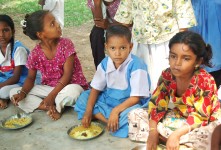
vrindavan_children_img2_blog India alone is home to around 40% of the world’s underweight preschool children3. Unable to receive proper nutrition and suffering from hunger in the crucial years of their development, their growth is further hampered by the compounding problems of poverty and food insecurity. In fact, globally, more than half of all child deaths are caused directly or indirectly by hunger4 and children who are poorly nourished suffer up to 160 days of illness each year5.

Not only is their right to life under threat, but also their right to development. 121 million children are out of school in the world6 and one third of those who do attend school drop out before they attain basic literacy and arithmetic skills.7Caught in a vicious cycle they struggle everyday for what is their right to a happy, healthy life.

The world has reiterated, stressed, emphasized, recognized the importance of, and resolved to do many things in the coming future, stating with great care the severity of the task at hand. There are quantifiable targets and achievable objectives and hundreds of papers written by erudite Phd holders on how it is important to ensure that a child is given basic rights, protected from exploitation, properly educated and encouraged to speak up.

But while the world managed to find an estimated $1.53 trillion dollars in 2009 to spend on its military, the United Nations has faced financial difficulties for two decades8. In fact, military spending is said to have increased during the global economic crisis.

Though there is still a tremendous need for increased efforts on the part of Governments, legislatures and societies before the state of the world’s children improves, some progress has already been made. In November of 2001, the Supreme Court of India passed an order mandating that “Cooked mid-day meal is to be provided in all the government and government-aided primary schools in all states of the country.” This gave rise to what has been termed the ‘mid-day meal scheme’.

The program, though it received nationwide implementation after the Supreme Court order, was already present in a few states of India, most notable of which is Tamil Nadu. In fact, the conceptualization of the program by K. Kamaraj, former Chief Minister of the state, is said to have been sparked by the reply of a small boy. When asked why he was herding cattle, instead of attending school, the boy replied, tongue in cheek, “If I go to school, will you give me food to eat? I can learn only if I eat.”

Today, the mid-day meal scheme in India, reaches out to an estimated 120 million children in government and government aided primary schools9 and is one of the most successful school lunch programs in the world. The success of the scheme can be attributed to public-private partnerships nurtured and developed by State Governments of the country, in which non-profit children’s organizations such as Akshaya Patra act as the implementing arm of the government. This approach has been so effective that NGOs today play a significant role in the scheme. Akshaya Patra alone reaches out to 1.2 million children across the country, an estimated 1% of the total number of nationwide beneficiaries.

Perhaps one of the most overlooked advantages of public-private partnerships is the awareness of developmental issues that they are able to raise.

Non-profits, with their network of dedicated individuals provide a more appealing human front than the Government, one in which deep rooted developmental concerns can be highlighted more easily to a country’s citizens. They bring the battle of poverty to the front door of the ordinary people, giving them with a tool to make a difference. The battle may be won, but the war has just begun. One in every three malnourished children in the world still lives in India. 10 One out of four children – roughly 146 million – in developing countries is underweight.11And of the 2.2 billion children in the world, 1 billion live in poverty. 12

Is the situation impossible to tackle? The people most qualified to answer this question are perhaps those who face the myriad complexities every day. Madhu Pandit Dasa, Chairman of Akshaya Patra is optimistic, “One thing is certain from this experience: there is boundless compassion in this world. We must involve more and more willing human hearts. It is possible, but only when we work together.”

After all, a child that is hungry must be fed…right?

1. http://en.wikipedia.org/wiki/Declaration_of_the_Rights_of_the_Child
2. http://en.wikipedia.org/wiki/Declaration_of_the_Rights_of_the_Child
3. Source: http://www.unmillenniumproject.org/documents/Hunger-lowres-chapter2.pdf
4. Source: “State of Food Insecurity in the World, 2005
5. http://www.worldhunger.org/articles/Learn/world%20hunger%20facts%202002.htm
6. Source: – The State of Food Insecurity in the World, 2005
7. http://www.globalissues.org/article/75/world-military-spending#WorldMilitarySpending
8. State of the World’s Children, 2005
9. http://en.wikipedia.org/wiki/Mid-day_Meal_Scheme#History
10. http://www.unicef.org/india/children_2356.htm
11. Source: The State of the World’s Children, UNICEF, 2007
12. State of the World’s Children UNICEF, 2005

read more
General

Run for fun… and a cause!

no thumb

On 31st May 2009, the small team of 35 people from Akshaya Patra, was charged with excitement. We were geared for the Majja Run at the Sunfeast World 10K Marathon, being held in Bangalore. Having collected at the Kanteerva Stadium, we were all set for the 5.6 Km run (or brisk walk!) that we were doing to garner support for our cause – unlimited food for education!

With the firing of the gun, our team started running, banner in hand and a smile on our faces. The thrill of running to create awareness for Akshaya Patra was tremendous and we were happy to be speaking about our work and program, to the media and interested individuals. Just like us, various charities had turned up to do their bit and people from all walks of life were running in the spirit of participation.

From the group of 35, 32 of us kept up to our promise to our donors – of running the entire 5.6 Km of the Majja Run; the remaining 3 – Ramaswamy, Williams, and Ravi, did even better – they ran the full 10 Km distance! A big ‘thank you’ to all the people who helped us generate funds from this initiative.

Since the past few years marathons have become a regular activity across the metros in India and each city hosts 2-3 marathons, half-marathons or night-marathons in a year. This is a wonderful opportunity for NGOs like us to tell the people about the work we do and inspire people to come forward to make a collective difference to society. While this time round, we put up a small effort, we would like to magnify this in the forthcoming marathons. We request those of you who would like to run the marathon in your city for Akshaya Patra, to mail us today! Our team of fundraisers will work closely with you to ensure that you are able to make your run more meaningful by asking people to pledge their support for your run. As you run for fun, make it an event to remember – not just for yourself, but for the 1 million children who benefit from your run, when you support for Akshaya Patra!

read more
1 59 60 61 62 63 65
Page 61 of 65