


close

Akshaya Patra Kitchen Stories

Akshaya Patra Kitchen Stories

Gorakhpur just got itself a new kitchen

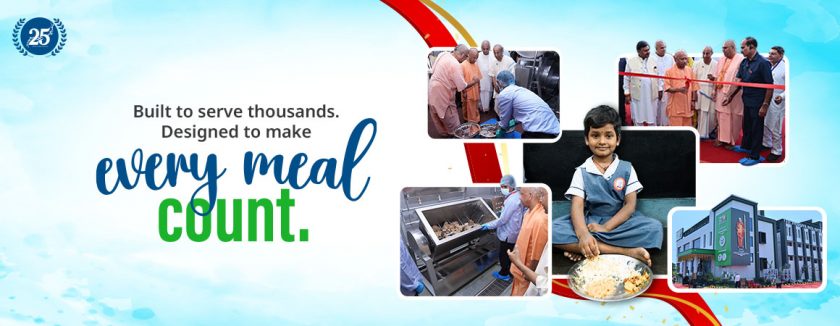
Built to serve thousands. Designed to make every meal count.

On 25 June 2026, the capacity of one lakh hot meals cooked by one kitchen every day stopped being a dream for Gorakhpur’s schoolchildren and started being a daily, delicious fact that will take its course soon. Here’s the story of the kitchen that’s rewriting what “scale” means for classroom nutrition.

Gorakhpur, Uttar Pradesh | 25 June 2026 | Capacity: 1,00,000 meals/day

Chapter One · Why this kitchen exists

Every Akshaya Patra kitchen starts the same way: with a very simple, very strong belief that ‘no child shall be deprived of education because of hunger’ should study on an empty stomach. Gorakhpur has been living that belief since 2019, when our meals reached about 5,000 children from a modest setup. Slowly, the numbers climbed… 17,000, then 35,000 across 310 schools. Good progress. But the city and the need, kept growing faster than the old kitchen could keep up. So we built a bigger one. A much, much bigger one.

The glow-up, by the numbers
This isn’t an overnight success story but five years of steady expansion, capped off by one very big leap.

  • 2019 – 5,000 children, first served
  • Early growth – 17,000 children via a temporary facility
  • Scaling up – 35,000 children across 310 schools
  • 25 June 2026 – 55,000 children across 546 schools, day one
  • The horizon – 1,00,000 children, 1,570 schools, phased
  40,000 rotis rolled out every hour     23 electric vehicles on delivery duty   25th year of Akshaya Patra’s journey

Chapter Two · Meet the kitchen’s powers

This kitchen didn’t just get bigger. It got smarter. Think of it less like a kitchen and more like a very well-organised superhero team.

The Roti Machines
Automated roti-making units work side by side, together capable of turning out roughly 40,000 soft, hot rotis every hour without a single one going missing in the count.
Solar panels + biogas
Solar panels and a biogas setup share the load of powering and fuelling the kitchen, cutting down on pollution because feeding a city shouldn’t cost the planet.
The EV Fleet
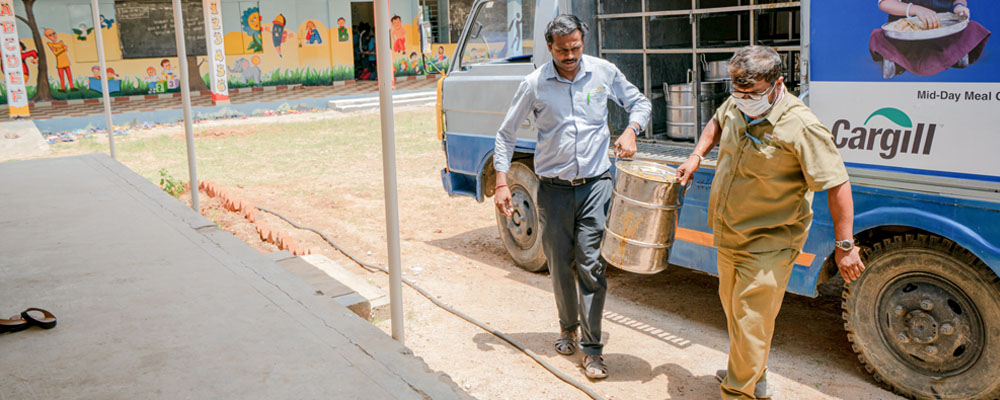
23 electric vehicles fan out across Gorakhpur and its neighbouring areas every single day, making sure meals reach schools while they’re still steaming hot.
The Reach
From 546 schools on opening day to a planned 1,570 schools, this kitchen was built to grow into its full capacity of one lakh children in careful, deliberate phases.

Chapter Three · The big day

The inauguration itself felt like the celebration it was. Uttar Pradesh Chief Minister Shri Yogi Adityanath, as Chief Guest, was joined by Minister of Primary Education Shri Sandeep Singh to formally open the doors. It was, at its heart, a partnership moment… the Government of India, the Government of Uttar Pradesh and Akshaya Patra, all showing up for the same cause.
“A healthy, well-nourished child today becomes the foundation of a stronger, more capable nation tomorrow,” a sentiment the Chief Minister returned to throughout his address, tying nutrition directly to education and national growth.
After the ribbon was cut, the Chief Minister toured the facility, inspected the arrangements and served meals to the children himself.
Before he left, the Chief Minister planted an Amla (Indian gooseberry) sapling on the kitchen premises as a small, quiet gesture, but a fitting one. Both the tree and the kitchen are built to nourish and both need years of steady care to reach their full potential.

Chapter Four · Why we keep building kitchens

One kitchen. Three things it quietly fixes at once.
01: Hunger, addressed daily
A hot meal removes the single biggest reason a child skips school in the first place… an empty stomach.
02: Attendance, strengthened
Where the meal shows up reliably, so do the children and so does the learning that happens once they’re in the room.
03: A generation, better fed
Under PM POSHAN, this kitchen turns a national nutrition promise into something as concrete as a plate on a desk.

Twenty-five years in, and the kitchens are still just getting started. Every rupee helps power the next roti machine, the next EV, the next school on the list. Support a child’s next meal.
read more
Akshaya Patra Kitchen Stories

Akshaya Patra’s First Ever All-Women-Run Kitchen

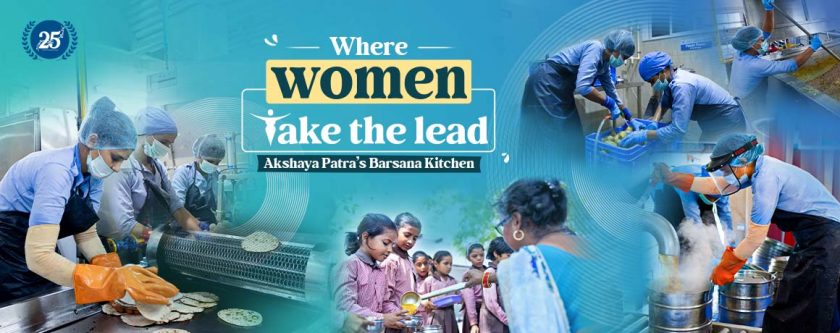
Where women take the lead – Akshaya Patra’s Barsana Kitchen

In the village of Ajnokh in Barsana, Uttar Pradesh, an Akshaya Patra kitchen implements the School Feeding Programme for thousands of children. But behind its operations lies a remarkable shift – it is Akshaya Patra’s first women-run kitchen.

Every morning, a group of women wakes up with hope and shared commitment to bring change.

Unlike in earlier days, when they had limited opportunities to achieve financial freedom (something that extends to freedom in other realms), this kitchen is setting an example of what women can achieve when they are given a chance to lead.

Many local women, who once stayed at home cooking, looking after their children and managing household chores, now carry a vision that extends far beyond their own kitchens – to serve nutritious meals to thousands of children across the region under PM POSHAN (Mid-Day Meal Scheme).

The Story of the First-Ever Akshaya Patra’s Women-Run Community Kitchen

Imagine a community kitchen where women lead every stage of operations – from meal preparation to kitchen management. How empowering it looks! This is exactly what is happening in our Barsana Kitchen, Uttar Pradesh. Since its inception in April 2023, women run the kitchen, ensuring every meal is prepared with care, quality and efficiency. As it successfully completed three years of service in implementing the Mid-Day Meal Scheme, the kitchen is currently run by 36 women and serves more than 5,000 mid-day meals every day.

Why Only Women?

The core purpose of Akshaya Patra is to empower communities through meals. We believe that when women are empowered, it will create a ripple effect, strengthening families, improving children’s well-being and building more resilient communities. Barsana Kitchen embodies this philosophy. While addressing classroom hunger by serving nutritious meals, Barsana Kitchen also gives employment opportunities for rural women, helping them achieve financial independence, build confidence and play a greater role in their families and communities. The impact extends even further by sourcing fresh vegetables and other raw materials directly from farmers, strengthening the regional economy. In doing so, the kitchen contributes to addressing broader socio-economic and gender-related challenges, paving the way for long-term social development.

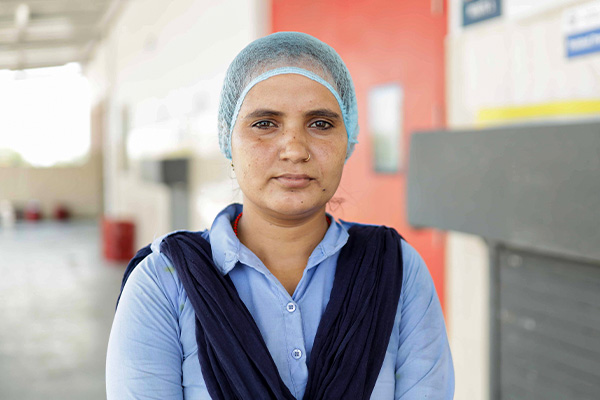
Pooja’s Journey at Barsana Kitchen

“Earlier, I stayed at home all day looking after my children. But working here gave me an opportunity to do more for my children.”

Pooja’s day starts at 3 AM on workdays. After waking up, she gets ready to go to the Barsana Kitchen, where she has an important role to carry out – prepare meals for schoolchildren. As a cook, she prepares dishes such as kheer, dal, subzi and kadhi, etc.

Talking about her role, she says:

“I feel good working here for children. I work as I do for my children at home. Many parents find it difficult to provide nutritious food for their children. This affects their studies and leaves them behind.”

My niece studies in one of the government schools we serve. She likes the food we give. I also like working with other women here. We help each other during challenges; it makes the work environment extremely peaceful.”

Earlier, as a widow, Pooja stayed at home all the time looking after the children. Her mother-in-law suggested her to apply for this job. Now, she feels good to be employed.

“We want to take Akshaya Patra further ahead. We want to show that women can do what men can and much more. I don’t have a single complaint about my job here. We all work here happily, with profound coordination,” she concludes.

This kitchen has a major role in giving local women employment opportunities beyond farming. It has empowered them with financial freedom, decision-making power, technical skills and most importantly, the confidence to shape their own life. Today, these women are able to provide better food and education for their children, boosting their confidence and dignity.

Meals and Hygiene

All the meals are prepared adhering to the local palate. The weekly menu includes roti, vegetable curry and bananas on Mondays; Dal-rice on Tuesdays; khichdi and kheer on Wednesdays; roti-subzi on Thursdays; khichdi and kheer on Fridays and kadhi-rice or dal-rice on Saturdays.

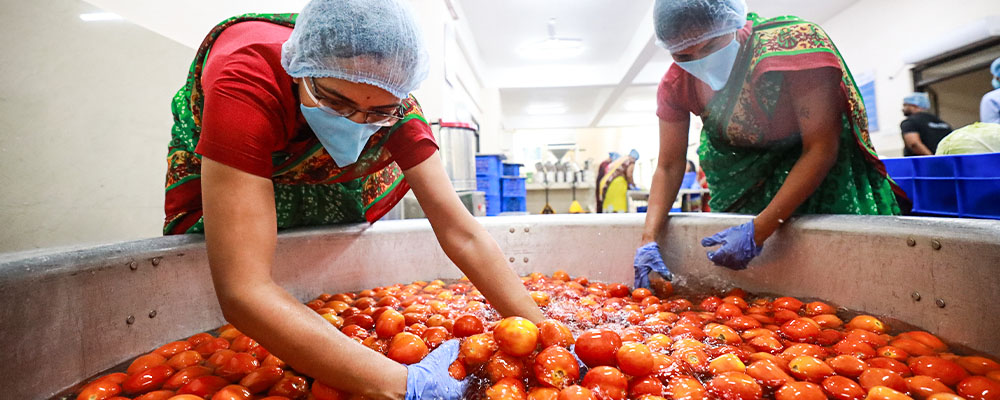
Every stage of preparation follows strict hygiene standards. This semi-automated kitchen is FSSAI certified, ensuring compliance with food safety standards. All the kitchen staff use head caps, face masks, shoe covers and food-grade nitrile gloves, which are safely disposed of after use. The kitchen’s current capacity is to prepare and serve 10,000 meals daily.

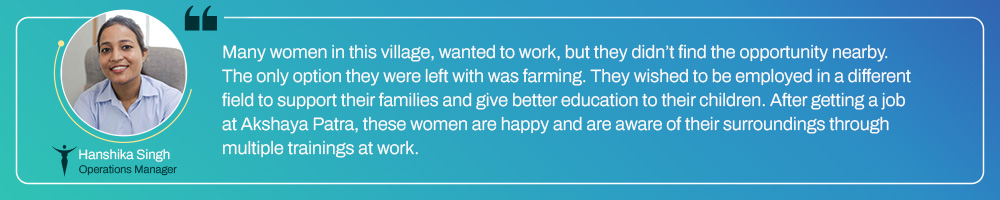
Hanshika Singh – Operations Manager

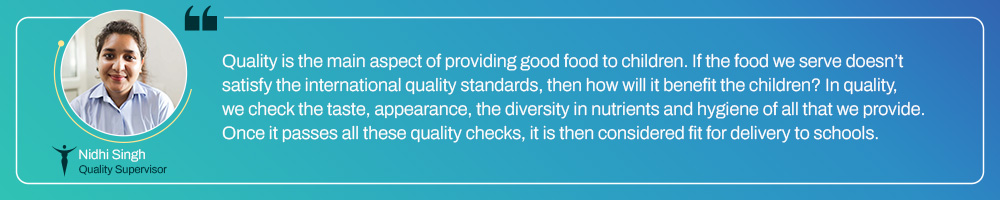
Nidhi Singh – Quality Supervisor

Barsana Kitchen is the story of a group of resilient women in the village who have become the backbone of its daily operations, helping build a hunger-free, self-sufficient future. Each meal prepared here under the Mid-Day Meal Scheme enables change not just in children but also in these women’s lives.

If you wish to support this cause, donate online and help us reach more children while advancing women empowerment.

read more
Akshaya Patra Kitchen Stories

From Kitchen to Classroom: Akshaya Patra’s Meal Journey

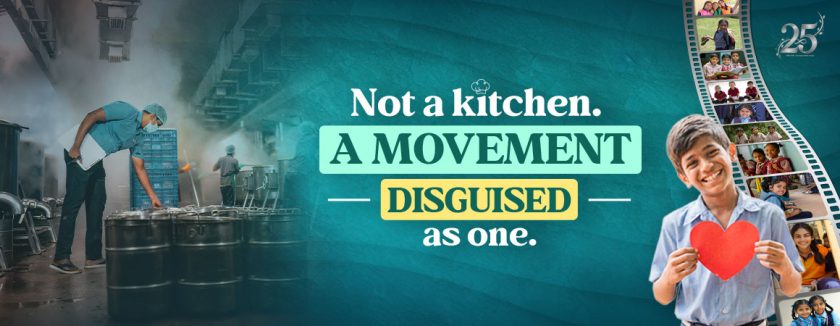
Not a kitchen. A movement disguised as one.

A day inside Akshaya Patra’s mega-kitchen… the fragrance, the hustle, the hearts and the 4 AM alarm that feeds a nation.

Walk into an Akshaya Patra kitchen before sunrise and you’ll be hit by warmth before you see a single pot, the warmth of steam, of purpose, of 200 people moving in choreographed chaos to do the most ordinary extraordinary thing: cook lunch for thousands of children who might not eat otherwise.

This is what a social enterprise smells like at 5 AM. Rice being washed in industrial drums the size of small cars. Lentils soaking overnight. The first ladle of ghee sliding into a pan so large you could swim in it. And above it all, the quiet, sure-footed belief that a hot midday meal is a right.

Akshaya Patra operates 78 centralised kitchens across India, preparing and distributing meals under the Government of India’s PM POSHAN scheme (formerly Mid-Day Meal Programme). The sheer scale is staggering but inside the kitchen, the scale disappears. What remains is craft, care, and a faint smell of cumin that never quite leaves your clothes.

We don’t count meals. We count futures. Every pot we fill today is a classroom that won’t be empty tomorrow.
– Kitchen Supervisor, Vrindavan Hub

From 4 AM to the Last Bell

4:00 AM
The kitchen wakes before the city does
Lights flicker on. The first team clocks in, many having commuted in the dark. Grains are measured, sorted, and washed. The day’s menu is confirmed on a whiteboard. The kitchen hums to life.

5:30 AM
Industrial burners roar to life
Vessels holding 200–500 litres are filled. Cooking begins in batches: rice first, then dal, then sabzi. Each station has a lead cook who has memorised portions, timings and spice ratios for thousands. No recipe card in sight.

7:00 AM
Quality is non-negotiable
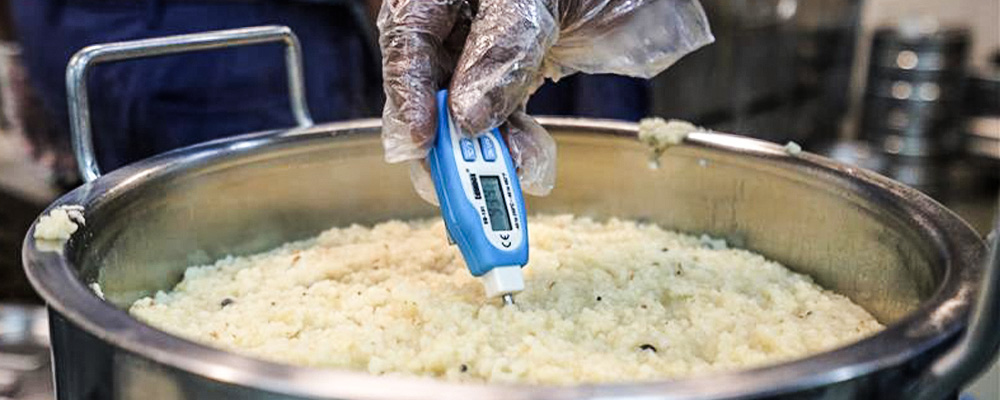
Each batch is taste-tested before it moves forward. A dedicated quality team checks temperature, texture, and nutrition balance. The dal must be soft. The rice must not clump. A mediocre meal is sent back — full stop.

8:30 AM
Packing and loading begins
Food is portioned into insulated containers coded by school, route, and serving time. A GPS-tracked fleet of vehicles queues at the loading bay. Every meal must arrive hot within four hours of cooking, always.

9:00 AM
Vehicles roll out across the city
Drivers navigate school corridors, rural roads, and traffic jams with the precision of a surgical team. Some routes wind through villages where roads are barely paved. The meal arrives anyway. It always does.

12:00 PM
2.35 billion children sit down to eat
Plates clatter. Rice is served. Kids who skipped breakfast because there was none eat properly perhaps for the only time that day. The kitchen, hours away, knows nothing of this moment. And yet it made it possible

The Sensory Tour
What does a kitchen like this feel like?

Tempering spices
Mustard seeds popping in hot oil. Curry leaves hitting the pan. The snap of red chilli. Your eyes water slightly. You inhale anyway.

500 litres of rice
Starchy steam so thick it fogs your glasses. A mist of cooked grain that smells like every grandmother’s kitchen, multiplied by ten thousand.

Industrial-grade ghee
It arrives in 15-kg tins. When it hits a preheated surface, the whole hall fills with a nutty, golden warmth. Your stomach growls involuntarily.

The hum of the hall200 people. 15 burners. Pressure cookers at full whistle. Ladles the size of paddles stirring. The sound is not noise, it’s rhythm.

People of the Kitchen

In their own words

I’ve been cooking here for eleven years. My daughter now studies in one of the schools we serve. I pack her meal myself; I know it’s safe, I made it.
Savitha R.
Lead Cook, Bengaluru Kitchen · 11 years

People think it’s just a canteen job. It is not. We feed 80,000 children every single day. When I stir that pot, I think of 80,000 faces. That’s not a job. That’s a calling.
Mohan K
Kitchen Supervisor, Jaipur · 7 years

The hardest part of my day is the easiest part too, it’s when the truck leaves. Everything I worked for since 4 AM is in those containers. And I know it’s going to reach a child who’s waiting.
Priya T
Dispatch Coordinator, Chennai · 5 years

Every meal is a promise.
Come see how we keep it.

Akshaya Patra welcomes volunteers, donors and partners who believe that no child should go to school hungry. The kitchen doors are open to those who want to make a difference.

Join the Mission

read more
Akshaya Patra Kitchen Stories

The Heart of Akshaya Patra: A Journey Through Our Kitchens Feeding Millions

Official Blog-MDM-1160×450

As aspirations soar high and challenges run deep, the mid-day meal (MDM) plays a vital role in transforming young lives. At The Akshaya Patra Foundation—a social impact organisation committed to addressing classroom hunger and malnutrition—our kitchens are at the heart of this transformation. These state-of-the-art Akshaya Patra kitchens are more than just culinary spaces, they are centres of innovation, efficiency and compassion, working tirelessly to nourish the dreams of millions of schoolchildren every day.
Scaling Nutrition with Precision

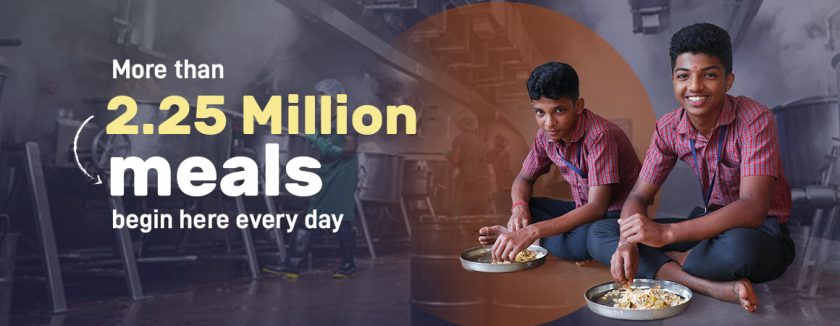
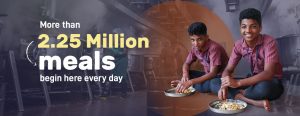
Feeding over 2.25 million children across 16 states and 3 Union Territories every school day is a monumental responsibility. At the core of this mission lies an unshakable commitment to scale with precision. Every Akshaya Patra kitchen is meticulously designed to ensure consistency in quality, hygiene and nutrition.
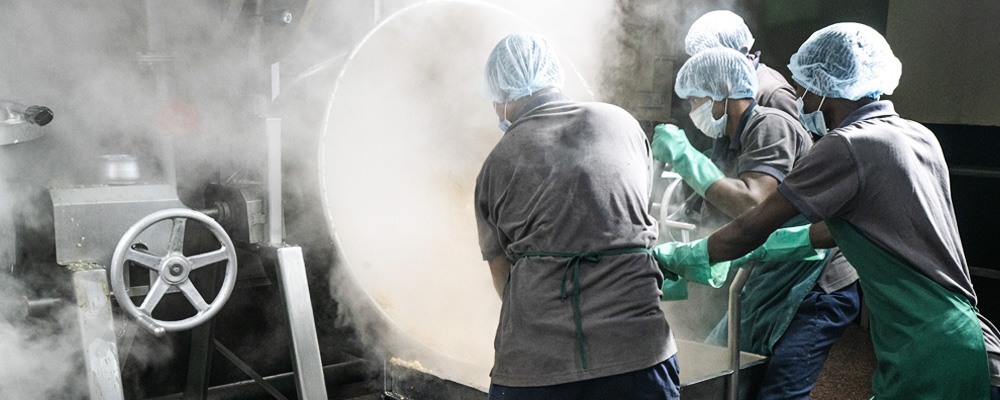
Some of our centralised kitchens have the capacity to cook up to 1,00,000 meals in under four hours. These kitchens operate combining modern machinery with time-tested processes. From vegetable cutting to steam-cooking in stainless-steel cauldrons, every step is carefully calibrated to retain nutritional value and flavour. The meals are then packed in insulated containers and dispatched in custom-designed vehicles to reach schools in time for lunch.
Ensuring Hygiene and Safety at Every Step

Maintaining hygiene in large-scale food preparation is non-negotiable. We follow strict food safety protocols as per ISO 22000:2018 standards and FSSAI guidelines. Regular tests, pest control, utensil sanitisation and staff training are part of our routine.

In every Akshaya Patra kitchen, the workflow is thoughtfully structured to avoid cross-contamination, from the delivery of raw materials to the dispatch of cooked meals. RO water is used for cooking, while raw ingredients are sourced from FSSAI-certified suppliers. Our kitchen staff are equipped with safety gear, including gloves, headgear and aprons, ensuring both personal safety and food hygiene.

Innovation at the Heart of Every Kitchen

Innovation is not an afterthought; it is built into the core of every Akshaya Patra kitchen. Each facility is tailored to its geographic and logistical context. For instance, our kitchen in Jaipur features gravity-flow mechanisms that minimise human touch, while the Vasanthapura kitchen in Bengaluru integrates biomass briquette boilers to reduce carbon emissions.

We continually adapt and improve our systems, be it route optimisation using GPS-enabled vehicles, data-led inventory management or solar-powered facilities. Our kitchens are examples of how technology can amplify the impact of social good.

A hot, nutritious meal has the power to change the course of a child’s life. For many beneficiaries of the PM POSHAN Programme (MDM Scheme), the meal they receive from Akshaya Patra is often the first meal of their day and sometimes, the only one. It’s not just about feeding children; it’s about enabling children to learn, grow and pursue their dreams without the burden of hunger.

The typical Akshaya Patra menu is designed and varies across regions to reflect local tastes and dietary habits. From khichdi in Gujarat to sambar-rice in Tamil Nadu and roti-subji in Rajasthan, our meals are both culturally relevant and nutritionally balanced.

People Behind the Process
Behind the high-efficiency machinery and streamlined logistics are thousands of individuals, kitchen staff, drivers, nutritionists, quality officers and volunteers, who pour dedication into every meal served. Their commitment exemplifies our values of service, precision and empathy. Each one contributes to a chain of care that begins in the kitchen and ends in the smile of a well-fed child.

The success of our kitchen operations is made possible through robust public-private partnerships. We operate within the framework of the Government of India’s PM POSHAN initiative and supplement this support with contributions from individual donors, corporate CSR initiatives and philanthropic foundations.
These partnerships enable us to upgrade kitchens, pilot innovative technologies and enhance the reach and efficiency of our operations. As a trusted organisation, Akshaya Patra’s kitchen models are frequently showcased as a benchmark for large-scale, high-impact interventions in school nutrition.
Mission we Breathe

Each Akshaya Patra kitchen tells a story of hope, scale and impact. It is here that the invisible threads of planning, compassion and efficiency are woven into tangible acts of service. As we continue to grow and reach more children, we remain anchored in our mission: No child in India shall be deprived of education because of hunger.
Through the heat of the cauldrons, the rhythm of logistics and the dedication of our teams, the heart of Akshaya Patra beats strong in every kitchen, every meal and every child we serve.
As we continue to nourish young minds through our kitchens, your support can help us reach even more children with the promise of a hot, nutritious meal.

Together, we can ensure that every child is brought back to school every day.

read more