
close
Food and Education

Feed a child and avail 100% tax exemption

tax-exemption

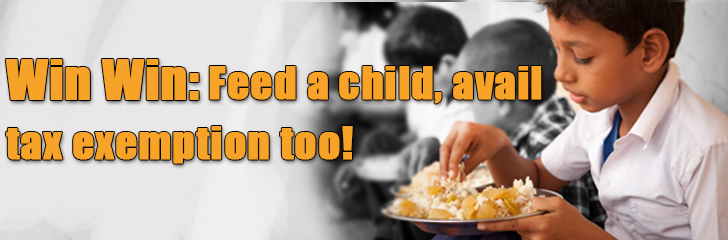
The financial year is drawing to a close and the catch phrase of the season is ‘tax exemption’. Now availing of tax exemption is bound to make you feel good, but we’re here to tell you that we know a way for you to feel even better! How about receiving tax exemption and feeding a hungry child, all at the same time? Now that sounds like a win-win situation.

Akshaya Patra is registered under section 35 AC/80 GGA of the Income Tax Act 1961, which allows us to sanction 100% tax exemption to Indian citizens for every donation above Rs.500. This is especially advantageous since most other NGOs are registered under Section 80G of the Income Tax Act which allows them to sanction only a 50% tax exemption.

The other advantage is that you don’t have to wait long to receive the proof of your contribution. Within ten days of making the donation you will receive an acknowledgment receipt, a 100 per cent tax exemption certificate and a thank you letter via courier or post from the Foundation.

If you’re an NRI (Non-Resident Indian) and would like to make a contribution, you will also be eligible for the 100% tax exemption under section 35 AC/80 GGA of the Income Tax Act!

So don’t worry anymore about how to receive tax exemption, and spend your money well too. Make a contribution towards eliminating classroom hunger and enjoy the double benefits right away. Make an online contribution here.

If you have any questions check out our Tax Exemption Donation FAQs, or email us at infodesk@akshayapatra.org

read more
Food and Education

Managing big data with ERP

erp-blog
Akshaya Patra's mid-day meal programme feeds over 1.4 million children across 23 locations in India every day. So can you imagine the mammoth scale of operations undertaken in every Akshaya Patra office and kitchen every
read more
Discussion Room

5 complexities of India’s hunger problem

blog

We all want to end child hunger. That’s a no brainer. When we look around and see those under-served, we all yearn for a world where there is enough food for everyone. But hunger is a very complex problem, especially in a country like India.

Here are some elements that need to be considered for us to create a reliable strategy against hunger.

Lack of fresh data – The last reliable data on the weight and height for children and adults, critical in determining the malnutrition levels of the country, were issued a decade ago, in 2005-06.

However the situation is on the mend with the National Family Health Survey scheduled for release at the end of next year. In the interim, UNICEF and the Union Ministry of Women and Child Development have conducted the ‘Rapid Survey on Children’ for more information.

Recognising Hidden Hunger – It is vital to combat not just under nutrition, but micro-nutrient deficiencies too. Hidden Hunger, which is the chronic deficiency of crucial vitamins and minerals, affects an estimated two billion people worldwide.

The role of myths and superstition – Social myths about health practices (in rural and tribal regions especially) can get in the way of administering medication that fights malnutrition and vitamin deficiencies. Educating mothers, fathers and in-laws can be an effective way to overcome superstition and nutrient deficiencies together.

Children of tribals and other minorities – The children of minority communities are often the most deprived. Stamped with social stigma and lacking access to nutrition, the children from these sections are usually nutritionally deficient.

In fact, according to a 2009 report by the NNMB (National Nutrition Monitoring Bureau) on the Diet and Nutritional Status of Tribal Population covered across 9 states of India on children of the age group of 1-5, 52 per cent were malnourished, from which 20 per cent were severely malnourished.

Developing an interim plan – All our concerted efforts are working to turn the tide against child hunger in India. Meanwhile, we need an interim plan of how to support children and their families financially and medically, provide sustainable nutrition, education, and be their support system in this period of change and development.

These are some of our thoughts on India’s ‘hungerscape’. We’d love to know if you have something to add to this list. Let us know by commenting below.

read more
1 37 38 39 40 41 66
Page 39 of 66