close
Engage With UsFood and Education

Food Security: A Step towards Peace

peace-day-banner

Amid the cacophony of wars and violence in the world, the dove of peace finds it difficult to make a successful flight. However, peace remains something to strive relentlessly for, if we are to leave behind the world that is worth inheriting. The United Nations has dedicated September 21 to world peace, in a bid to promote peace education and prevent war.

The reasons for conflicts across the world and their impact on the livelihoods of people in conflict zones are many, but one issue that doesn’t get the attention it deserves is that of food insecurity. Food insecurity plays an important role, not only in driving conflict but also in sustaining it. According to a report titled Harvesting Peace: Food Security, Conflict and Cooperation, published by the Woodrow Wilson International Center for Scholars, food shortage and famine led to a never-ending loop of instability in countries such Somalia. High prices of food staples also triggered civil unrest and initiated food riots and food wars in numerous countries around the world. Food insecurity also provided an impetus for people to take part in conflicts and rebellions.

The onus lies on governments and the people of the world, to ensure food security for populations across the planet. The Food and Agricultural Organization of the United Nations (FAO) says that interventions related to food security can help build resilience to conflict. The FAO supported a government programme in the Democratic Republic of Congo, giving kits to former combatants, which led to them forming a fruitful association to arrange food and integrating them into civilian lives. Such initiatives are necessary if the vicious cycle of food insecurity, violence and instability are to be broken. As American biologist and Nobel laureate Norman Borlaug said, “If you desire peace, cultivate justice, but at the same time cultivate the fields to produce more bread; otherwise there will be no peace.”

This International Day of Peace, bring contentment to the hungry stomachs of children. Help children secure one nutritious meal per day, which will help keep them in school.


Make your contribution today.

read more
Food and EducationSchool Note

Diary of a School Girl

Diary-Of-A-School-Girl

Dear Diary,

Today’s Science class was very interesting. Our teacher taught us about Human Body. Until today, I did not know there were so many bones in our body. 206? That’s a lot. I’m only 12 years but it feels like I’m learning so much already. My school is my only distraction from all the problems at home.

Dear Diary, let me tell you about my life. We are five people in the house. Dad works as a coolie in the railway station and my mother is a housewife. I have an elder brother at home who is now in high school and I have a baby sister who is still in Anganwadi. It’s been two months since I moved to 7th Standard and I enjoy going to school. Exams make me nervous at times. I wake up at 6 am every day to help my mother with kitchen work. We do not have any water supply in our house and so I fetch water from a public tap. Our family needs at least six to seven buckets of water every day—for the kitchen, bath and to drink. In all this rush, I sometimes forget to eat breakfast. In school, our headmaster says ‘Breakfast is the most important meal’ but I feel I do not get the time to eat.

I leave home at 8 am with my best friend Uma. She stays close to my house and I’m happy we are classmates. We talk a lot in class and we laugh a lot. It takes 30 minutes for us to walk to school. We don’t realise the passing time because we talk so much. Once we reach school, we work on pending homework or we play a game. At 9 am, the entire school gathers for Morning Prayer. We sing the National Anthem ‘Jana Gana Mana’ every day. We also drink a glass of milk before classes begin.

Our classrooms are not big but we have everything we need. There are eight benches in my classroom and the walls are covered with informative charts. Some of the charts are made by us. We have six different classes every day. My favourite is Kannada—the teacher makes it so much fun. In our Kannada textbook, we have a lesson about farming. To make it more interesting, our teacher took us to the ground and made all of us plant a sapling. We water them every day and look after them like the plants are a part of our family. When we do not have any class, we usually sit quietly and read our textbooks. If anyone talks, our class leader writes the names on the blackboard. I always get caught for talking or laughing but I also focus on studies.

We get free lunch at school. At 11.45 am, Akshaya Patra vehicle delivers the food to our school. At 12 noon, lunch is served to everybody. We all eat together and wash our own plates. We usually get Rice and Sambar for lunch but sometimes, we get Bisi Bele Baath or Puliyogare. On most days, the lunch in school is the only meal I get to eat for the day. In fact, my parents sent me to school only because we get free lunch and the burden on the family is less. I’m happy too because the food we get is hot and contains vegetables. Most of us don’t like vegetables but our teachers make sure we all eat them because it makes us healthy.

Once a month, our teachers check our height to record the progress. I’m still 4 feet. I hope I grow taller this year. Before the last bell, we spend time drawing something or we play a game. One of my classmates draws cartoons and that’s very interesting. I like making rangoli designs. My school ends at 3.30 pm every day. We sing Vande Mataram before we leave the classroom.

Once the school is over, I walk back home with my friend. Like every day, I help my mother with fetching water and making dinner. At 5 pm, I step out to play with my neighbours. We play so many games in the evening. Sometimes, my mother lets me watch television. I like watching Chhota Bheem on Pogo. From 7 to 8 pm, I do my homework. If I finish my homework early, I get to watch more TV. After dinner is made, I help my baby sister eat her dinner and I put her to sleep. I try to sleep on time so that I’m fresh the next day. I’ve also been learning that sleep is very important for our bodies to function on a daily basis. I hope I get to become a Science teacher when I grow up.

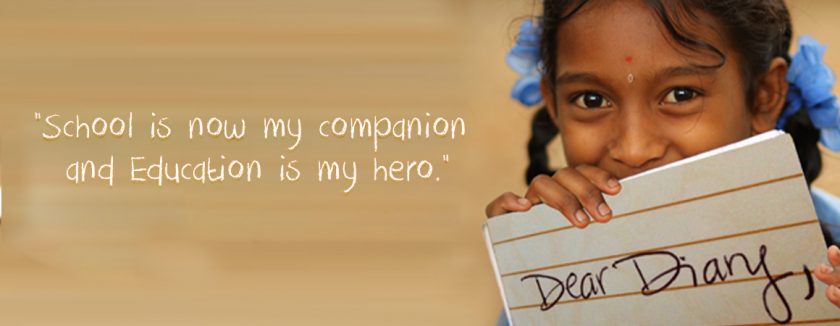
This is my first journal entry and I hope I write more.  My school is now my companion and education is my hero. Thanks to the Government and to Akshaya Patra, I’m able to study without any disturbance.

Yours truly,
Lakshmi
(Inspired by true stories)

read more
Food and Education

A-Z of Akshaya Patra

blog
We have all learnt the English alphabet by associating each letter with something we were familiar with as a child. Let’s reverse the process. To help you get familiar with Akshaya Patra’s work, we have
read more
1 29 30 31 32 33 66
Page 31 of 66