
close
General

Internet to optimise development

Internet

Over the years, the Internet has gained so much significance and popularity, that it has involved with different kinds of businesses, institutions, organisations and all kinds of networks. The Akshaya Patra Foundation is one such entity to have benefitted massively from the internet. The organisation uses the internet for collation of information, communication, networking, information for collaboration and partnerships, fund raising and branding. Various channels like search engine optimisation, social bookmarking, social media marketing, e-mail marketing and blogging help in creating awareness and raising donations.

The internet lets the organisation place vast information on the global map like its history, operational structure and financial data. Besides, the Internet also lets the NGO share its case studies and success stories with the world. The not-for-profit organisation which provides free mid-day meals to 1.3 million children across India has benefitted immensely from social media networking.

The advantages of social media to NGOs are phenomenal. A single ‘like’ on the Akshaya Patra Facebook page or a single ‘re-tweet’ by a famed personality on Twitter, posted on the Akshaya Patra Twitter page, has the potential to create maximum impact. It’s a platform for this organisation to engage with existing donors, volunteers and fans. It further helps in generating funds, garner supporters and in brand recognition.

The internet also helps in maintaining records, carrying out statistical analysis due to the availability of vast information and maintaining transparency, above all. A website can carry all the information that a donor, beneficiary or an employee would seek.

The Akshaya Patra Facebook page has 51,261 likes which is a 100 per cent increment from the previous quarter. Renowned personalities like Helen Clark of United Nations Development Programme (UNDP), Rajdeep Sardesai of CNN-IBN, Sonu Nigam from the entertainment industry have been following Akshaya Patra on Twitter and have also re-tweeted posts shared by the organisation. The organisation’s YouTube channel has about 111, 115 viewers. The NGO is also present on Google Plus, Pinterest and LinkedIn.


read more
Food and Education

World Food Day 2013

world-food-day-2013
World Food Day is observed every year on October 16 by many organisations concerned with food security and nutrition. The theme - "Sustainable Food Systems for Food Security and Nutrition" gives focus to World Food
read more
General

The ‘Never Ending Pot’ That Feeds India’s Needy Children

no thumb

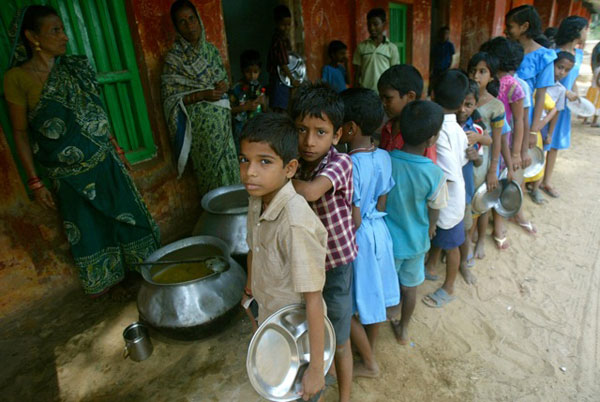
Twenty-three young students in the Indian state of Bihar died in July after eating a midday school lunch cooked with oil contaminated by pesticides. As a father of young children, I was deeply saddened by this tragic and easily preventable event. But through this heartbreaking incident I was reminded of my experience witnessing the  work of organizations such as Akshaya Patra that contribute to feeding India’s children.

blog-2In the last decade, India has experienced economic growth, but the majority of its population continues to face chronic food insecurity. According to UNICEF, one-third of the world’s malnourished children live in India.

In an effort to address this issue, India’s Supreme Court in 2001 directed all primary schools across the country to provide a free lunch to students. Instantly, the Midday Meal campaign became the largest school lunch program in the world, feeding more than 120 million children.

Just a year earlier, a group of Bangalore-based International Society of Krishna Consciousness, or ISKCON, monks had started a small pilot project to address the number of children in their state who were not attending school because they were forced by their parents to labor in the fields or on the streets.blog-3

Many of the children who did attend school rarely ate breakfast and could not concentrate because of hunger. The monks felt that if they offered a free meal to children who attended school they could have a double impact: get children to school for an education, and provide one substantial meal each school day.

The monks looked to the Sanskrit epic, the Mahabarat, for the inspiration for the foundation’s name. One of the central characters, Bhima, the second eldest brother of the five Pandava brothers, was known as a brave and vengeful warrior. Being a man of vast size and strength, he had a voracious appetite. Consequently, he was allotted half the family’s food, with the rest going to his four brothers. The five Pandava brothers shared a wife, Draupadi, who was responsible for feeding the family. To assist her in this mammoth task, Draupadi was given a cooking vessel that provided a never-ending supply of food. This pot was called the Akshaya Patra.

That group of monks had some ambitious foresight in selecting the name for the foundation, as each day Akshaya Patra now prepares 1.3 million fresh and healthy meals for schoolchildren in nine Indian states.

blog-4In India, tastes vary, so school meals do too

Having lived in India for four years, I was eager to see how one of Akshaya Patra’s 16 centralized kitchens operated. In spring 2010, I traveled to the eastern coastal town of Puri, in the state of Orissa. In the shadow of the famous Jagganath temple, I met with the kitchen manager Deelip at the kitchen set up to facilitate the preparation of the lunch meals. Deelip explained that to meet the demands of cooking such vast quantities of food in a hygienic manner, a kitchen staff of 30 starts at 2:30 a.m. to process 8,800 pounds of rice, 2,400 pounds of arhar dal and 8,800 pounds of mixed vegetables. By 6 a.m. all the food has been portioned into large, stainless-steel containers and waits on the back of delivery trucks for the journey to the 50,000 children at village schools.

Akshaya Patra realized early on that it would not be a good idea to impose unfamiliar flavors on children. Thus, the weekly rotating vegetarian menus consider regional taste differences and look to local markets for seasonal ingredients. For example, in the wheat belt of the northern Indian state of Uttar Pradesh, the kitchen in Vrindavan operates a roti-making machine that can make 40,000 chapatis in one hour. By contrast, in the southern state of Karnataka, the menus regularly include rice, sambhar and curd.

In a recent conversation CP Das, vice chairman of the Akshaya Patra foundation, said that as the foundation has grown it has continued to focus on three key quality dimensions where food safety is the No. 1 priority, and the nutritional and flavor aspects of the food are close behind.blog-1

The foundation also operates a few small decentralized kitchens in rural areas under similar conditions as the one at the school in Bihar. However, they have been able to overcome the rustic settings by addressing basic operational logistics, such as access to clean water, hygienic conditions in which to prepare and store the food, and the presence of trained monitors to help prevent corruption and contamination. Das clarified that Akshaya Patra is currently training more than 200 women who operate decentralized government school kitchens in rural Bihar.

Despite its success, there have been critics that state it is illegal for Akshaya Patra and ISKCON-Bangalore to collect donations in India and abroad while at the same time receiving money from state and national governments for the midday meal program. Its critics further claim some of the monies have been used for real estate investments and to make board trustees wealthy. Das denies the charges and highlights a 2010 report by the House Committee of the Karnatakan Legislative Assembly that indicates the foundation did not misuse any government funds and there is nothing wrong in collecting donations to maintain high food-quality standards. He explains the government funding covers 60 percent of its operational costs and they rely on donations to cover the remainder.

Das is particularly proud that in areas where Akshaya Patra operates, a noticeable increase in attendance, particularly of girls, has occurred. But he knows Akshaya Patra can do more.  The foundation’s hope is that more state governments will invite them to set up kitchens to fulfill their mandate that no child should be deprived of an education because of hunger.


Zester Daily contributor Cameron Stauch is a Canadian chef living in Hanoi, Vietnam. In Canada, he cooks for the Governor General of Canada..

read more
1 46 47 48 49 50 66
Page 48 of 66