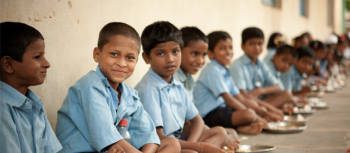

The story of the Hubli kitchen is a humble one. What started off as a small kitchen, turned out to be a boon not just for Akshaya Patra but for over 126,000 children who get their mid-day meals from this kitchen every day. The unit operations manager Yagneshwara Dasa has been at the Hubli kitchen since its inception and explains how their work has expanded over the period of 10 years. “We were feeding 4,000 children in 2004. Initially, we got a very good response and the numbers started increasing gradually from 10,000 to 50,000 working from a small kitchen, till we were reaching at least 80,000,” he said.
When the Government of Karnataka allotted a bigger plot for kitchen operations on the outskirts of Hubli, no one knew it would turn out to be one of the biggest Akshaya Patra kitchens in India. In fact, Hubli was the first mega-kitchen following the centralised model with advanced technological initiatives, and acted as a model to the other kitchens that were later built. With help from a small team of devotees, professional architects and some students with an engineering background, the kitchen was designed and fitted with state of the art facilities.
The new kitchen follows a gravity flow model, very different from the earlier single layer kitchen. At the commencement of the new kitchen, there were three floors allotted to undertake everything from cooking to packing and delivering to schools. “These layers help in standardising the operations here at the kitchen,” said Yagneshwara Dasa.
The standardising of operations was one of the main concerns for Akshaya Patra. Quality being the highest priority, the organisation worked towards getting ISO 22000:2005 certification and thereby standardised their operations across all kitchens. With 11 kitchens already certified, the rest are working on getting the certification. The Hubli kitchen was one of the first to be certified after the Bangalore kitchen and is among the most economical kitchens across the country.
The operations manager said that the work at the kitchen progress smoothly even as the number of meals and the responsibilities of the team increases. Every process in the Hubli kitchen is meticulously looked into by the supervisors who coordinate the operations. The quality department works with vendors, who provide food and keep the vendors updated on the latest information to help them adhere to the food quality standards. Stringent quality checks are followed at every level from the point where materials are purchased to food delivery to the schools. He adds “the quality norms here are very stringent because you have to realise that we are giving the food to thousands of children.”
Yagneshwara Dasa certainly realises that and so do the 320 employees of the Hubli kitchen, who shoulder this responsibility with such grace and dedication.
Read more about the Hubli kitchen in an update coming soon.