close
Discussion Room

India’s Millenium Development Goals: A semi-success story

millenium development goals

We are now less than 450 days from the deadline to the completion of the Millenium Development Goals, and it’s time to take stock of where India stands in achieving these, and make a final push towards victory. The Millenium Development Goals were agreed upon in a declaration made in the year 2000, and signed by over 189 countries across the world. Out of 8 goals this article will focus on the first two which are critical to India’s progress and closely related to Akshaya Patra’s cause.

The first goal is to eradicate extreme hunger and poverty. This goal has two targets through which it can be achieved. The first target is to ‘halve between 1990 and 2015 the proportion of people whose income is less than one dollar a day.’ The progress made towards achieving this target can be judged across three indicators:

  • Poverty head count ratio (This is the percentage of the population below the national poverty line)
  • Poverty gap ratio
  • Share of poorest quintile in national consumption

Poverty rates in India dropped from 45% in 1994 to 34% in 2005, and according to the latest NSS survey (National Sample Survey) it has further dropped by 5% from 2005 to 2010. So it is clear that India has made some progress in reaching for this target, but there’s some way to go yet.

The second target is to ‘Halve between 1990 and 2015, the proportion of people who suffer from hunger.’ The indicator to measuring progress of this target is:

  • Prevalence of underweight children under three years of age

In this India has made less progress. With malnourishment estimated at 52% in 1990, India needs to reduce it to 26% by 2015. However in the stretch from 1999 to 2006, the malnourishment rate declined by only 3% from 43% to 40%. Unless a concentrated effort is made to achieve this target, at the current rate of decline India will have a 33% rate of malnourishment by 2015.

The second crucial goal is to achieve universal primary education. India aims to achieve this through the target of ensuring that ‘by 2015 children everywhere, boys and girls alike, will be able to complete a full course of primary education.’ The indicators to measure this target are:

  • Net enrolment ratio in primary education
  • Proportion of students starting grade I who will reach grade V
  • Literacy rate of 15 to 24 year olds

With respect to this goal India has had tremendous success. According to the Net Enrolment Ratio (NER) and DISE (District Information System on Education), in 2009-10 India had an enrolment score of 98.3%. These figures make it highly likely that India will achieve its target of ensuring 100% NER for boys and girls well before 2015!

However it is in implementing the second target, of increasing the number of children continuing in primary school from grade I to grade V that India is struggling. As can be seen from the table after an initial burst, sustained primary school enrolment has been fluctuating in recent years.

1999  ⇒  62%
2002  ⇒  81%
2004  ⇒  73%
2008  ⇒  72%
2009  ⇒  76%

However, more good news is that India is also looking at a high probability of achieving 100% youth literacy (literacy rate of 15-24 year olds) by 2015. According to the NSS in 2007-08 alone the urban literacy rate stood at 93% and the rural at 83%.

These figures are inspiring and daunting at the same time. However with only a little more than a year to go it’s time to decide what the world’s next step should be in this battle against poverty, malnutrition and illiteracy. The suggestions outlined by the Open Working Group for Sustainable Development Goals for the next 15 years provide a way forward, but it is up to each of us, each country, and each Government to translate these endeavours into success.

Source: Millenium Development Goals India Country Report 2011 – http://www.undp.org/content/dam/undp/library/MDG/english/MDG%20Country%20Reports/India/MDG_India_2011.pdf


read more
General

Making the most of IT

IT-BLOG
Keeping abreast with changes in information technology (IT) is crucial to any organisation that wants to scale up and increase productivity. If a company is growing, your dependence on IT will grow with it. Output
read more
Food and Education

Akshaya Patra Kitchen, Hubli: Moving Beyond

hubli-kitchen

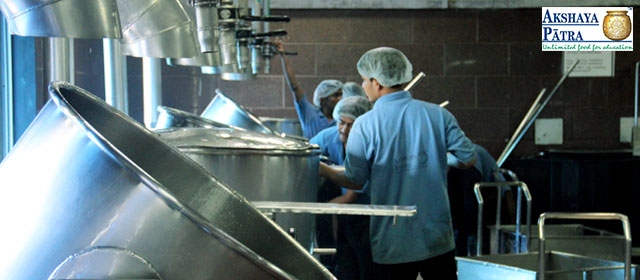
The Akshaya Patra kitchen in Hubli has an impressive efficiency rate when it comes to preparing large amounts of meals. As mentioned in the earlier article ‘From traditional to contemporary,’ the Hubli Kitchen is rated as one of the most economical kitchens of Akshaya Patra in India. Like any other kitchens of Akshaya Patra, quality is of utmost importance to the Hubli kitchen. It’s a human inclination to recognise great taste and this kitchen has gone beyond making healthy and nutritious meals for children. The kitchen ensures a meal with a new taste every day. “Any attraction to the food must be its taste. Normally for children, feeding them is a big task. You can imagine how a mother feeds her child, but when children come to school, there is no one to feed them and tell them they have to eat,” explains operations manager, Yagneshwara Dasa. It is the food lab team that makes sure a meal with a different taste is served every day. They carefully formulate a menu keeping in mind that the nutrients in the food should be proportionate.

Ensuring quality at every stage, every day

The quality assurance team at the Hubli kitchen sees that all the quality standards are met. The quality team at the warehouse briefs the vendors on the quality standards. At every stage the ingredients are examined. At the warehouse, the operations team follows a process called first-in and first-out. For example, the potatoes procured by the kitchen are stacked in the warehouse. The first lot of potatoes has to be removed first because if it is kept for too long, it will start decaying. Simultaneously, more goods coming in and overloading will be a problem. “We make sure what came in first is moved out and used. We also have minimum stock levels. For any ingredient, there should be a sufficient stock in the warehouse at all times. The warehouse is stacked with all the materials which are needed for the preparation,” said the operations manager.

The rice to the kitchen is supplied by the Food Corporation of India (FCI). The FCI follows a public distribution system of providing food grains. The dal (lentil, pea or various types of bean) and vegetables are acquired from vendors who follow the safety and health standards set by the kitchen. To avoid monotony, there are 25 recipes of sambar (lentil based curry), with a different dal being used every day. They indulge in sprouting these dals on a weekly basis which makes the food more nutritious. “Surprisingly, the children are very fond of the sprouts and we have received good feedback on this,” Yagneshwara Dasa added.

No insufficiency of food at schools

The team makes certain that there is no scarcity of food at schools. There are 38 different routes to the schools. They find out how many students are absent. Based on these numbers, they calculate the total figure. A cumulative format has an indent for every route. Citing an example, the operations manager said that one route will consist of 25-30 schools. They calculate the number of school children in that particular route. With the help of this format, the team is able to find out the number of students to feed every day. It ensures that no child is left out and some children are able to take food back home happily.

Pushing beyond to reach the isolated areas

The operations team at Hubli is now trying to reach out to more school children especially in remote areas. Several villages surrounding the twin cities of Hubli and Dharwad are sometimes completely cut off during the monsoon. Delivering food to such areas can pose a major challenge. The team is making conscious efforts to reach these areas to feed school children. A hard-hitting fact, mentioned by the operations manager, is that sometimes the Akshaya Patra mid-day meal is the only meal a child has in a day. For this reason, Akshaya Patra is pushing boundaries to reach out to more children and to prevent hunger amongst children and the youth.

Transparency of its operations

To demonstrate transparency and emphasis on quality, the Hubli team organises inspection tours at the kitchen for the school children and teachers. “We want the students and teachers to come see our kitchen. We want to encourage children to eat more and not keep themselves hungry. We also want to show them the standards of hygiene we maintain. It boosts the confidence of the children when they see the food being prepared. And they should understand that we are doing this for them,” the operations manager concluded.

read more
Food and Education

Share in the joy of giving

joy-of-giving-week-daan-utsav
Joy of Giving Week (currently called Daan Utsav), is celebrated in India between 2nd and 8th October every year. As India's largest philanthropic event the Joy of Giving Week is a crucial time when all Indians
read more
1 40 41 42 43 44 66
Page 42 of 66